


FUNCTIONAL HARMONY
Updated: Jul 31
Functional harmony was formalized by Hugo Riemann (1849–1919), drawing inspiration from the concept of mathematical function. Between the 17th and 18th centuries, Jean-Philippe Rameau already described chords as vertical structures and introduced the concepts of subdominant, dominant, and tonic. Even earlier, Monteverdi (1567–1643) employed V–I cadences, which are typical of functional harmony.
Functional harmony has distant origins and reflects an ancient human need to conclude on a chord or a note perceived as more important than the others—a center of gravity. What distinguishes functional harmony from the more general concept of tonal hierarchy is a codified system that regulates harmonic progressions. This system favors the leading tone, the tritone, and the V–I cadence, also known as the perfect cadence.
SCALE DEGREES
In functional harmony, the notes of the scale are called degrees. Simply put, if we choose the C major scale, C is the first degree, D the second, E the third, and so on. Each degree has a specific role or function within the musical discourse: some generate tension and movement, others are more ambiguous, and the first degree is the only one with a function of resolution or rest. In functional harmony, the two most important degrees are I and V. The first degree represents rest or the conclusion of a musical phrase and is perceived as “home,” while the fifth represents movement and tension.
CHORDS
A chord is built on a scale degree and reflects its function. In traditional functional harmony, suspended chords and other chord types are considered incomplete or directionally ambiguous, and triads and seventh chords are preferred.

Degree | Function | Triad | Example in C | Example in A |
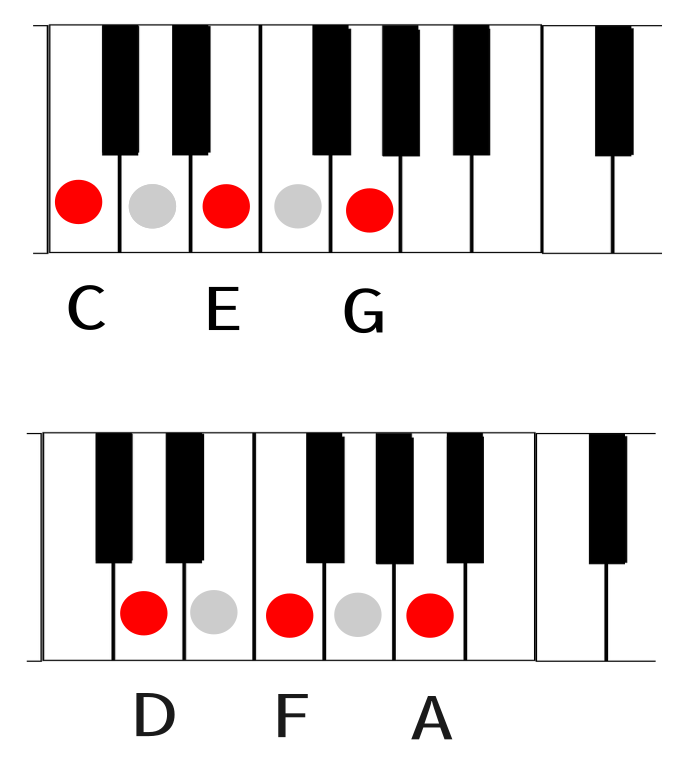
I | Tonic | Major | C | A |
II | Supertonica | Minor | Dm | Bm |
III | Mediant | Minor | Em | C#m |
IV | Subdominant | Major | F | D |
V | Dominant | Major | G | E |
VI | Submediant | Minor | Am | F#m |
VII | (Dominant) | Diminished | Bdim | G#dim |
THE LEADING TONE
The leading tone is the note located a semitone below the tonic or one of its octaves. This note generates strong tension and creates a powerful pull toward the first degree. In the major scale, the leading tone is the seventh degree. In other scales, the leading tone may be absent, which, according to traditional functional harmony, can be problematic. The leading tone is also one of the two notes that form the tritone.
THE TRITONE
The tritone is the interval of six semitones between the fourth and seventh degrees of the scale. This interval is crucial in functional harmony and is associated with tension and movement due to its dissonance and the presence of the leading tone, which pushes toward the tonic. The tritone is contained within the diminished triad built on the seventh degree and within the seventh chord built on the fifth degree. In the key of C major, it consists of the notes F and B.
CONCLUSIONS
Functional harmony is ideal for giving music a lyrical sense, where a beginning and an end are perceived—a point of departure and a point of arrival. It is well suited for storytelling, emotional expression, and creating moments of tension and release. Although this harmonic perspective is still widely used today, freedom in note choice, alternative tunings and modal systems, suspended chords, and inharmonic timbres have made musical direction more diffuse and the tonal center more ambiguous. Functional harmony remains a living language, but today it coexists with many other sonic logics: modal, timbral, and atonal. In some cases it remains a valuable key; in others, a framework that has become too restrictive.
RECOMMENDED READING
Cambridge History of Western Music Theory, p. 726
James Tenney, History of Consonance and Dissonance


Comments