


INVERSIONS
Updated: Jul 31
The most effective way to formulate a chord is to start from the fundamental, its own center of gravity, and build the other intervals above it. However, it is not mandatory to always keep the fundamental in the bass; we can also have, for example, the third or the fifth as the lowest note of a triad. When the bass is a note other than the fundamental, this is called an inversion. The bass strongly influences our perception¹, and it is clear that if the lowest note of a chord is not the fundamental, the chord will feel somewhat less stable or more ambiguous.
ROOT POSITION
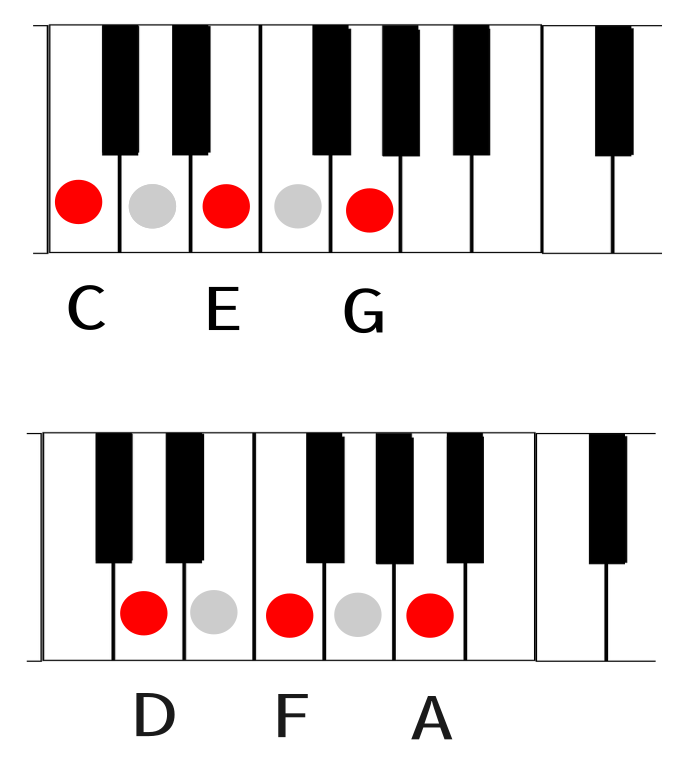
When the root of the chord is in the bass, we are in safe territory, referring to the original form of the chord, which is very intelligible. To say that a chord is in root position, it is sufficient that the root is in the bass; the position of the other notes is irrelevant.

FIRST INVERSION
If we take a chord in root position and move the root an octave higher, the bass will then be the third. This is the simplest way to form the first inversion starting from a root position chord in close position, but we can define a “first inversion” as any chord that has the third in the bass. Ending a phrase on this chord allows the bass to remain slightly open, and it is often preferable to resolve with a root position chord to give a clearer sense of closure. Nevertheless, this inversion is ideal in a triad to create variety without causing disruption.

SECOND INVERSION
If we take a chord in root position, in close position, and move not only the root an octave higher but also the third, we easily obtain the second inversion. More simply, we can call “second inversion” any chord that has the fifth in the bass. The second inversion in triads can be tricky because having the fifth in the bass destabilizes the harmony and it can be mistaken for the root of the chord. Of course, if the second inversion is only used as a passing chord within a context dominated by the tonic, no ambiguity is necessarily created.

WHAT THEY ARE FOR
They allow the bass to move without having to follow the root: if the root is far away, inversions give access to other chord tones, like the third and fifth, so the bass can choose between wide leaps or smaller, stepwise movements.
They allow choosing different ranges of the register while keeping the same chords.
They allow developing a melody with the top notes of the inversions without changing the chords.
They enable more comfortable harmonic connections for the fingers on the instrument.
OTHER INVERSIONS
With chords of four or more notes, additional inversions are possible, and we can speak of third inversion, fourth inversion, and so on.
EXAMPLE
Even the most basic chord progression, where each chord plays on the beat in quarter notes, can gain a bit of variety through the use of inversions, as shown in the example.

NOTES
The bass occupies frequencies between 30–250 Hz, on which the brain builds tonal perception and harmonic stability. Its long waves travel through walls and spaces, as they are too large to be absorbed or blocked by common materials, and our tonal perception relies on them.

Comments