


I, IV and V DEGREES
Updated: Jul 31
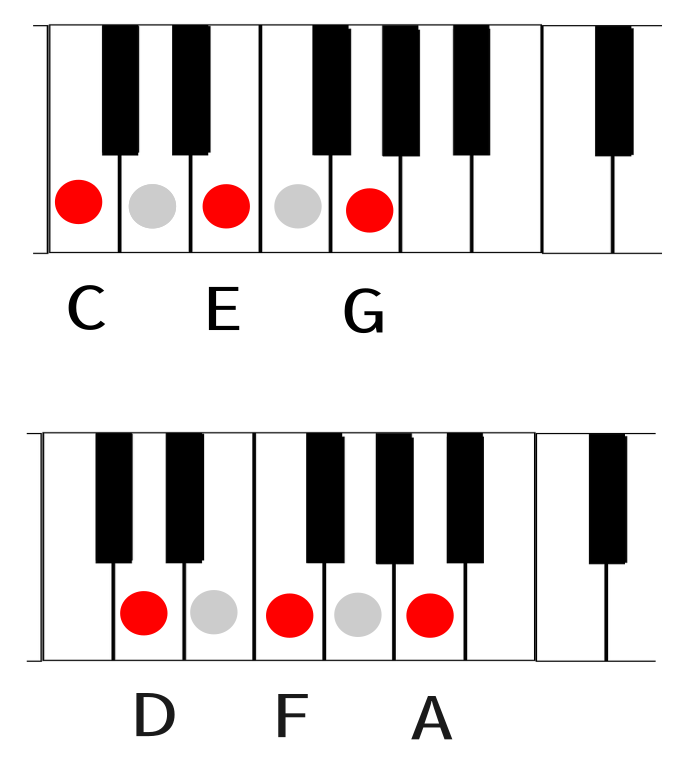
According to functional harmony, every chord built on the degrees of a scale has its own specific role (function). Taking the notes of the major scale as an example, we can build triads on each degree. On the I, IV and V degrees we find the major chords:
GRADO | TIPO DI TRIADE | ESEMPIO IN C |
I | MAJ | DO - MI - SOL |
II | MIN | RE - FA - LA |
III | MIN | MI - SOL -SI |
IV | MAJ | FA- LA - DO |
V | MAJ | SOL - SI - RE |
VI | MIN | LA - DO - MI |
VII | DIM | SI - RE - FA |

I – IV – V
In a major scale, the I, IV and V degrees contain the only major triads. These triads, besides having a clear and “happy” sound, are also those that represent the closest keys in the circle of fifths, and they are usually the first chords considered when learning the functions of each degree. Moreover, if we combine all the notes from these three chords, we obtain all seven notes of the major scale.
The specific roles, or functions, of these chords make it possible to develop a rich musical discourse and to construct a real harmonic punctuation.
I DEGREE: TONIC (C – E – G)
The first degree is built starting from the first note of the scale. It is also called “home”: the center of attraction, peace, the point of arrival, and the resolution. For this reason, it is the most important degree and represents the harmonic stabilization of the tonality. It is where phrases or musical periods often end. The first degree is also called the TONIC.

IV DEGREE: SUBDOMINANT (F – A – C)
The IV degree (F major in the key of C) contains the tension of the fourth note of the scale (F in the C major scale) and that of the sixth note of the scale (A in the C major scale), but it also includes what Mauro De Maria calls “the molecule of peace”, namely the tonic (C in the C major scale).
For this reason, the IV degree is considered a semi-tension, and in functional harmony it is called the SUBDOMINANT. Usually, the semi-tension of the IV degree is placed before the strong tension of the V degree, creating a kind of rest–semi-tension–tension climax, the typical I – IV – V progression, which often resolves on the I degree.
Many pieces are built on an I–IV pendulum, a two-chord progression that balances coherence and contrast, tension and release, and rarely becomes boring. If a phrase ends only with IV–I, skipping the V, we obtain what is called a plagal cadence.

V DEGREE: DOMINANT (G – B – D)
The V degree is almost as important as the first degree. It contains a significant level of tension and is often used to generate movement toward the tonic, that is, the first degree.
The motion fifth → first is perhaps the most important harmonic movement in Western harmony and is frequently used to conclude musical phrases.
The V–I cadence is called a perfect cadence. The V degree is also called the DOMINANT.

EXAMPLES
The Bobby Fuller Four - I Fought The Law


Comments